Sunday, 31 January 2016

Muscari azureum (Pseudomuscari azureum)

Pseudomuscari azureum (syn. Muscari azureum), the azure grape hyacinth, is a species of flowering bulbous perennial, native to Turkey. It is grown in gardens for its spring flowers. Azureum means "bright blue", a reference to its flower colour.


Description
Pseudomuscari azureum is a small plant, around 4–15 cm (1.6–5.9 in) high with two to three grey-green leaves per bulb. Up to 60 flowers are borne in Spring (March or April in the Northern Hemisphere) in a dense "spike" (raceme). Each flower is 4–5 mm (0.16–0.20 in) long and bright blue in colour with a darker stripe along each of the lobes. A feature which distinguishes the genus Pseudomuscari from the related Muscari is that the mouth of the flower is not narrowed but forms an open bell-shape. It grows in alpine meadows in north and east Turkey.


Cultivation
P. azureum may be found in horticultural sources under the illegitimate name Hyacinthus azureus. It is still widely referenced under its previous name Muscari azureum. The species is popular as a spring-flowering bulb though rarely offered for sale in average garden centres. It can be used in rock gardens or underneath shrubs. It is frost-hardy and should be grown in full sun. It has gained the Royal Horticultural Society's Award of Garden Merit. There is a white cultivar, 'Album'

Thursday, 28 January 2016

Iris fulva - the copper iris

Iris fulva is a rhizomatous perennial, native to the southern and central United States. It has deep bright red flowers and bright green leaves.

It is not widely grown in the United Kingdom.

I first heard about it Dan Pearson's book 'Sanctuary in the city' in which he talks of obtaining iris fulva from Piet Oudolf, the famous Dutch plantsman.

Ever since then I have been on the hunt for it.

It is frost hardy in Cambridge UK. I grow it both in large pots and in a shallow marshy area, both receive a lot of sun. Apparently these need a bit of spring sun and warmth to flower well.

They have reliably flowered for me with the most beautiful colours.


It normally flowers between spring and early summer, between April and June, with 1 or 2 flowers per axil of each alternate leaf along the stem. There can be as many as 4-6 (occasionally more) flowers per stem. The blooming period lasts for about 3 weeks.

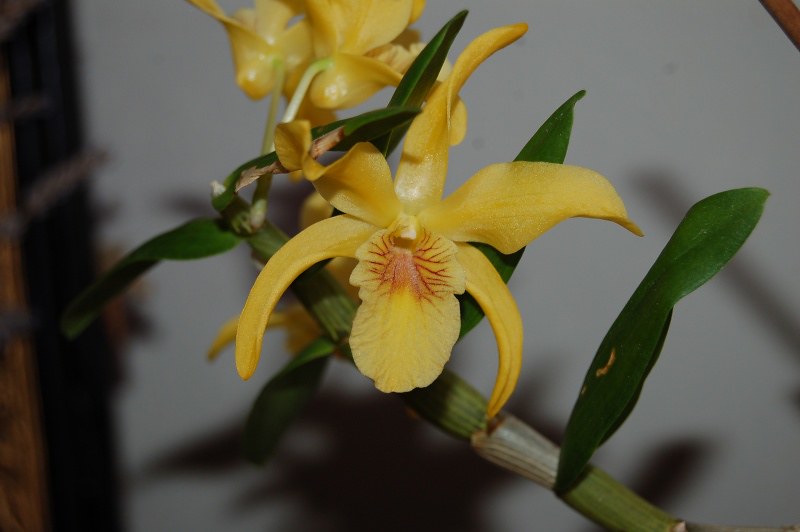
Dendrobium Stardust Firebird

Dendrobium Stardust Firebird is a complex hybrid crossing between Dendrobium unicum, monoliforme, heterocarpum (syn. aureum) and signatum.

I grow it in intermediate conditions, with 12-14 degrees C at night in winter, in an east facing window that gets sun both in summer and in winter. I grow it in a very fast draining mixture, and let the growing medium dry out thoroughly before watering again.

Some suggest it needs a nobile type dry winter rest, but I have found that seems to weaken the plant, which looses its leaves and then subsequent canes are smaller. Instead I water it weekly throughout the year.


Flowers form on last years canes, and on any nodes on previous years' canes that haven't yet flowered. It flowers in the spring (northern hemisphere, London UK) for me, around April - May, with flowers that are a beautiful orange. The Stardust Chyomi hybrid flowers a month or so before. The flowers last for a good 4 to 6 weeks and are beautiful.

Saturday, 23 January 2016

Dendrobium delicatum culture

Dendrobium Delicatum is a naturally occurring hybrid between Dendrobium kingianum and Dendrobium speciosum var hilli


It occurs along the Great Dividing Range in south east Queensland, as a lithophyte.

D. x delicatum is primarily a lithophyte (growing on rocks). It is variable in habit, which is to be expected as its parents are also variable in habit. 

The pseudobulbs can be up 20 to 35 cm long, thickest near the base and tapering towards the apex. There are usually 2 to 5 thick leaves at the top of each pseudobulb, the leaves being 75 to 175 mm long. The bulbs and leaves are very thick and are resistant to pest. The plant has a lovely profile and looks great in a terra cotta pot. 

Flowers occur on 250 mm long stems in clusters of up to 14 or more flowers. They are usually pure white to cream with purple dots on the labellum and are usually long lasting and sweetly scented. Flowers are seen from late winter to spring.

Any free draining compost will do for this plant, which is not really fussy. It is a fast grower and prolific bloomer. 
Temperature.
D x delicatum is very well suited to outdoor cultivation in temperate regions, with frost protection in a greenhouse or conservatory during the winter. It should not be grown in dense shade or flowering will be discouraged. 

Watering can be done freely during spring, summer and autumn and  should be kept to a minimum during winter.

Tuesday, 19 January 2016

Graptopetalum paraguayense - Mother of Pearl Plant - Ghost plant

Origin and Habitat: Graptopetalum paraguayense, originally thought to be native to Paraguay, as the species name implies, was first ‘discovered’ in a load of cactus plants imported to New York in 1904. No plants of the species have been rediscovered in the wild since. The ssp. bernalense was found in 1979 by Alfred Lau on the Cerro Bernal mountain range of Tamaulipas state in NE Mexico, and it is thought that this may be near the home of G. paraguayense also. Another possible variation, ssp. mendozae, was found much more recently.


Description: Graptopetalum paraguayense is a clump-forming, perennial succulent with a basal rosette of thick fleshy leaves resembling Echeveria. The common names include Mother-of-pearl-plant and Ghost plant probably with reference to the look of the greyish white, opalescent leaves. This is not to be confused with Monotropa uniflora which is also referred to as the “Ghost Plant”. Plants turn pinkish yellow in hot, dry conditions and blue-gray when pampered with partial shade and regular water. They bear star-shaped, white-and-red flowers in spring. Graptopetalums may form crested growth.

Habit: Graptopetalum paraguayense is a hairless, perennial rosette-forming, succulent plant, looking like an Echeveria but unlike Echeveria the rosettes grow at the tips of ever-lengthening stems creating a low spreading colony to only about 30 cm tall. 

Rosettes: 9-15 cm across, with c. 15-25, loosely shingled, leaves, and forming a symmetric Fibonacci spiral. Old leaves at the base of the rosette wither and fall off. New growth is from the centre of the rosette, so over time the stem gets denuded, with a rosette on the end.

Leaves: 2-8 cm long 1.5-2.5 cm broad, thick triangular to spathulate, pointed, flat or hollowed above, keeled beneath. The leaves range in colour (even on the same plant) from grey-green, pale blue, light pinky-lilac, to light purple and are covered by a greyish bloom giving the whole plants an opalescent shine (Exhibiting a milky iridescence like that of an opal or pearl). The thick leaves hold excess moisture so the plant can withstand periods without rain.

Flowers: Star shaped, white with small red specks, c.2 cm in diameter, borne on stems to 15 cm long with 2-6 branches, each with 3-14 flowers. Petals c. 1 cm long white, dotted with red. 

Blooming season: The plant flowers occasionally in late winter-early spring.


Cultivation and Propagation: Culture of Graptopetalum paraguayense is fairly easy, it can tolerate full sun (where it will stay compact) but a much better exposure is light shade. It is always a favorite carefree windowsill citizen, an excellent addition to any garden. The plant's origin will make its rosettes tolerate heat and drought. They are true survivors.

Exposition: Likes light shade to part sun (it will take a few hours of sun without a problem), but adapts very well to full sun and shade too. It can overwinters well also under grow lights in a cool room of the house. Graptopetalums are chameleons. Those grown in partial shade tend to be blue-gray; in full, hot sun, gray-pink; in full sun, pinkish gray to yellow.

Soil: Although it needs a soil that is gritty and porous with good drainage, the soil must be able to hold the moisture that the plant requires. The ideal soil should contain equal parts of loam with small gravel added (eg pumice or lava grit). Good drainage is essential.

Watering: During the summer growing period the plant appears to need much more water than the average succulent. Water when plant is dry and do not water again until the soil is completely dry again. Dislikes over-watering. Pay particular attention to make sure that they do not rot at the root from soggy soil. During October to March, water very sparingly, using only enough water to keep the foliage from shriveling. In a very humid situation in winter, it can rot even if totally dry. It likes dry air as much as dry soil. 

Hardiness: It is usually recommended to avoid freezing temperatures, but this is a very hardy succulent and can rebound from being frozen and is useful in areas that drop below 7° C. It requires low temperature for flower formation and it will not flower unless it is overwintered for at least a month at 15° C or less.

Pests and diseases: The tightly-packed rosettes can sometimes harbour mealy bugs, but generally it is pest free and easy to grow.

Uses: A great plant for use as a groundcover, in gravel gardens, paved areas, rockeries, in hanging baskets or pots, or for spilling over walls. Like all succulents it is not for planting in areas with much foot traffic. It is best to pick a good location for the ghost plant and then don’t move it. It mixes beautifully with other succulents and alpines.


Propagation: It is is propagated by the division of offshoots or by individual leaves, rooted in sand or in dry vermiculite. Any rosette that breaks off has the potential to root and start a new plant. Even a leaf that drops off will root below the parent plant and produce a new rosette quickly. Because leaves and cuttings root effortlessly, graptopetalums are among the easiest succulents to propagate.

Tuesday, 12 January 2016

Dendrobium Speciosum - the Rock Lily - Tar-Beri

Dendrobium speciosum is native to a vast section of Australia ranging from Mallacoota (37°33'S) south-east Victoria to the tropical conditions up past Cairns (16°57′S).

It is known as "Tar-Beri" to the aborigines, and "Rock Lily" or "King Orchid" to other Australians. It blooms extraordinarily flower-laden plumes, like bushy fox tails, of fragrant, creamy white flowers. The showy flowers grow in long racemes on straight or slowly arching, long, starchy stems with over 100 small sweetly fragrant flowers per stem from August to October in Australia, or February to April in the Northern hemisphere. Their color varies from white to creamy yellow. The white labellum is covered with purple dots and veined with red and purple.


There are two to five thick, leathery leaves originating from the top of each pseudobulb. These leaves can remain on the plant for up to 12 years. The erect or curved pseudobulbs are rather large, up to 45 cm long. They are thickest at their base (5 to 7 cm), and often taper towards the apex (3 cm).


Cultivation

This is an orchid that thrives on low-medium humidity, bright to very bright light and an open well drained pot with orchid compost.

A constantly moist root system is important, as in natural cliff faces they live on weep moisture constantly. Water all year round in moderation.I n the wild, it is nearly always growing on granite cliff faces or boulders in open grassy paddocks. The speciosum's root systems are often covered with a blanket of moist ferns and mosses.


These orchids are great growers and in time can get huge!

Very bright, open, breezy positions in the growing season seem to be the key to mass blooming.

Speciosums can be acclimatised to take 100% full-sun if slowly positioned into brighter and brighter light from late winter onwards. It is in these full sun positions that they will bloom annually without fail.

It is extraordinarily tough, hardy and drought tolerant. It can tolerate short periods of temperatures near frost to over 45°c without severe damage.

So, growing dendrobium speciosum is simple. Avoid frosts, unaccustomed hot sun, too much shade (make sure you can see a shadow when placing hand above foliage) and temperatures above 36c if possible. Anywhere that has similar conditions to south-eastern Australia will be able to grow this orchid with ease. In the UK the orchid will thrive in full sun outside during summer with overwintering in a cool greenhouse.

Pots should always have excellent drainage and not be too large in comparison to the orchid. As they are vigorous growers, re pot annually.  The compost should be open well drained and have about 25% rock present.

They are virtually free of pests, as their foliage is beautifully thick and sturdy. 

Some subgroups.

Because dendrobium speciosum is found over such a vast region, botanists have broken the species apart into many subspecies or varieties. The naming of these groups is subject to regular review and change!

The far Southern form known as dendrobium speciosum var speciosum is the easiest to grow (and most tolerant of low temperature). 

The deepest colour forms are unusual variants of speciosum var grandiflorum, these may be rich golden yellow, and sometimes in full sun almost a golden orange.

Generally a good rich daffodil yellow is to be expected. In nature most clones are a pale lemon or yellow/cream in colour, very rarely are true clear whites seen.

The shortest caned forms are the pedunculatum forms from furthest north Queensland. They may have fully mature blooming sized canes at only 3" tall!


The Hillii variety tends to produces clawed tiny blooms in pale creams on disproportionately giant canes, which is great in nature but not usually preferred by growers.

Saturday, 2 January 2016

Bowiea volubilis - climbing onion - unusual succulent

Bowiea volubilis subsp volubilis has an unusual succulent adaptation - climbing inflorescences that harvest photosynthetic light in the absence of aerial leaves. 


It is a deciduous climber which climbs to 3-4 m in surrounding vegetation or scrambles over rocks on hillsides. The bulb is large, reaching 150 mm in diameter, with several fleshy white scales becoming greenish-yellow if exposed. Stems are fleshy, bright green, much branched and function as leaves. 


Flowers are 16-24 mm in diameter, green, with stalks turning backwards. Fruits are in the 
form of an oval capsule, about 25 mm in diameter.


B. volubilis capsule


Distribution and habitatBowiea volubilis subsp volubilis  has a wide distribution and occurs in the eastern parts of South Africa ranging from the Eastern Cape to Limpopo Province. It extends north into Zimbabwe, Zambia, Tanzania, Uganda and Kenya and has also been recorded in Mozambique, Malawi and Angola. It grows generally at low and medium altitudes in a variety of habitats.


Bowiea volubilis flowers


Bowiea was named by W.H. Harvey to honor James Bowie (1789-1869), a plant collector for Royal Botanical Gardens, Kew. The genus is monotypic with two subspecies – volubilis and gariepensis - both occurring in South Africa. The epithet volubilis is a reference to the subspecies' twining growth whereas gariepensis is a reference to the geographical area of growth. The subspecies grow in separate geographical areas and show differences in floral, capsule and seed characters.


Bowiea volubilis subsp volubilistolerates wet and dry conditions, growing predominantly in summer rainfall areas, which receive approximately 200 - 800 mm of annual rainfall. It flowers between January and March.


Bowiea is used extensively for medicinal purposes for various skin diseases, sore eyes, bladder problems, barrenness, to facilitate delivery, and to procure abortions. Its magical properties are well-regarded. Warriors are made brave and invincible, travellers protected, and love procured with this strange-looking plant.
As a result, in southern Africa this species faces severe threat due to the medicinal market.


Growing Bowiea volubilis
Few seeds are set, making offspring numbers low. If fruit are produced, the fine black seeds should be harvested as soon as the capsules start to split. The seeds should be sowed immediately onto a mix of one third sand and two thirds bark in seedling trays, and left for germination in semi-shade.
Vegetative propagation of Bowiea volubilis subsp volubilis is extremely slow and requires expensive tissue culture systems.


Friday, 1 January 2016

Echeveria setosa v. minor

Echeveria setosa v. minor is a specific form of the Mexican Echeveria setosa. It is an evergreen.

E. setosa grows in semi-desert areas and is still common in the area Puebla.

It is not winter hardy and needs a minimum temperature of 7 degrees in winter.

In summer it can be grown outside in temperate areas.

It needs a good light and indoors a south facing window is ideal.

It needs good drainage, and generally minimal water in winter, with more water in summer.

E. setosa flowers in spring with unbranched inflorescences


Monday, 28 December 2015

Dendrobium Stardust Chyomi

Dendrobium Stardust Chyomi is a complex hybrid crossing between Dendrobium unicum, monoliforme, heterocarpum (syn. aureum) and signatum.

I grow it in intermediate conditions, with 12-14 degrees C at night in winter, in an east facing window that gets sun both in summer and in winter. I grow it in a very fast draining mixture, and my original plant is grown mounted on bark with a small wad of spagnum moss.


Some suggest it needs a nobile type dry winter rest, but I have found that seems to weaken the plant, which looses its leaves and then subsequent canes are smaller. Instead I water it weekly throughout the year.


Flowers form on last years canes, and on any nodes on previous years' canes that havent yet flowered. It flowers in the spring (northern hemisphere, London UK) for me, around March April, with flowers that are initially pale yellow and which become more deeply yellow as the plant ages. The flowers last for a good 4 to 6 weeks and are beautiful.


Tuesday, 22 December 2015

Pleurothallis rowleei, easy to grow, beginners orchid, beautiful

Pleurothallis rowleei is a species of orchid widespread in South America from Costa Rica, Columbia, to Ecuador. It is found at varying altitudes from 800 to 6000 feet above sea level. It is therefore very adaptable to varying temperatures and growing conditions, and can be grown in both cold/intermediate and hot conditions. It usually grows on the forest floor and likes moist conditions, with some shade and good drainage. It is a rewarding and easy beginners orchid.

It comes in varying color forms.

Thursday, 17 December 2015

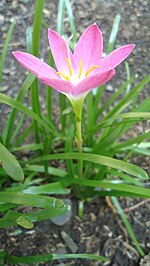
Zephyranthes rosea

Zephyranthes rosea (like other rain lilies) are so named because they produce short-lived flowers only after seasonal heavy rains or storms. In Z. rosea, this usually occurs during the late summer. The generic name Zephyranthes literally means "flowers of the west wind", from Greek ζέφυρος (zéphuros, an Anemoi) and ἄνθος (anthos, 'flower'). Zephyrus, the Greek personification of the west wind, is also associated with rainfall. The specific name comes from Latin for 'rosy'.

Zephyranthes rosea is native to Peru and Colombia. It is widely planted in warmer regions around the world and is reportedly naturalized in Florida, India, the West Indies, many of the islands of the Pacific and Indian Oceans.They are common in recently disturbed land and grassy areas that receive periodical rainfall.

Each plant has up to 6 evergreen leaves, 3 to 4mm wide. The six petalled flowers are about 2 to 2.5cm long and up to 3cm wide and are born singly, on stems of about 10 to 15 cm.

Sunday, 13 December 2015

Dendrobium Kingianum species and hybrids such as Berry Oda - Cultivation

Culture of Dendrobium kingianum species and hybrids

Dendrobium Kingianum hybrids are neat, compact, attractive plants, even when not in bloom, and they are easy to grow and reward one with an array of beautiful, long lasting, fragrant flowers in shades of white, white with colored lip, yellow, and plain and splash petals in mauve, pink, and purple.

This plant will grow vegetatively at any temperature, any light, and any kind of watering and feeding.

If you wish to bloom to its fullest potential, then those true to the species type  MUST be grown cool (min night temp in autumn and winter below 50F 10C); maximum light; lots of water when growing.

Dendrobium kingianum grows normally down to 35F 2C (and will tolerate temps down to 29F -2C), so the species type in temperate climates can normally be grown outside in spring, summer and winter in full east sun.

After blooming, all keikis are removed, as well as old flower spikes, and the new developing keikis are left on as they will remain uniform in size and will increase the amount of flowers.

All dendrobiums will produce keikis, however kingianum varies from clone to clone, and within reason this has nothing to do with culture. This is in contrast to nobiles, which make excessive keikis with too much nitrogen, or not enough sunshine. Certain clones, produce multiple keikis and if these are not removed after blooming the keikis make keikis, and these make keikis and soon there is a veritable weed patch. The usual keiki after removal can be planted and will make a new growth, perhaps a keiki, and all will usually bloom the following season.

The pot is watered enough to keep it moist, and during hot weather this may be every day.

In winter grow the plant somewhere frostfree and withhold water is until buds start to develop (6-8 weeks). At this time spray the leaves once or twice a week, and when the buds can be recognized resume watering the pot, once a week. After the flowers open  resume watering to keep the plant evenly moist.

Some clones can be watered the entire year, and bloom well ; others behave as the book advises and must be dried out if they are to bloom.


Canna Indica Cultivation

Cannas are very easy to grow. A canna started into growth in February/March in a cool greenhouse, and planted out at the beginning of June, will usually be flowering by July. It will then flower continuously all summer and autumn, each stem producing a succession of flower spikes, and new flowering stems growing from the ground. They will continue to flower until cut down by winter frosts when they are dug up and stored for the winter. It will then be seen that the original rhizome or plant has multiplied many-fold.

Cannas can be grown from rhizomes, by division of plants, and a few can be grown from seeds. There are pro's and con's to each method.

Pros and cons: rhizomes, plants, seeds
  • Rhizomes require more work, and also need a greenhouse, and they may be infected with virus disease unless you are VERY careful where you obtain your stock.
  • Cannas from small plants, either by division or purchased as plants, are the easiest to grow, you simply plant then in the garden when the frosts are over, and away they go. If you are buying them as plants, then they can be inspected for virus disease at the time of purchase (any naff-looking plants being discarded), but they are usually much more expensive than rhizomes.
  • It would be nice if cannas coud be grown from seeds, but the problem is that many cannas are sterile and do not produce seeds. Where they do produce seeds they usually don't come true. You may get something interesting, but it probably won't look like the parent
Cultivation by Rhizomes
Rhizomes are usually started off in greenhouse between February and April. Individual rhizomes may be planted in 2 litre pots, using a rich compost preferably enriched with a little fertiliser. Alternatively, 3 rhizomes may be planted in a 6 litre pot.
As with many rhizomatous plants, not every rhizome will grow (canna growers are happy with an 80% success rate), although some rhizomes will throw up 2 or 3 shoots.
Take great care with emerging shoots, which are extremely fragile.
Plants remain in the 2 litre or 6 litre pots until planted out, or potted-on for pot cultivation. The earlier they are started into growth the earlier they will flower. They are fairly hardy and heat is not essential except to protect against frost. They should be ready to plant out when the danger of frost is over in late May or early June. They will then soon start to flower. Flowering will be continuous until they are lifted in early October, or until they are cut down by winter frosts.

Cultivation by small plants/divisions.
Cannas are not fussy creatures. You can divide them at any time of the year, even when in full growth. Provided you give them a good watering after this trauma they will hardly notice. Otherwise their treatment is as for rhizomes.

Cultivation from seeds.
The seeds of the Tropical Series flower in 90 to 120 days from sowing the seeds, which is quicker than most cannas when grown from rhizomes. Seed from the species C. warszewiczii and C. patens are almost as quick. If you wish to try growing cannas from seeds produced by some floral hybrids, then if you sow the seeds in February, they should be flowering by August.
Canna seeds are glass-hard. They will not germinate unless scarified. If scarified, they will germinate in about 1 week. Scarifying canna seeds is an engineering job. We grip the seeds in pliers, and rub them on an engineers file, just enough intil the white shows theough at one point. The best conditions for germination is very hot (30C), and very wet.
Floral varieties not known to produce seeds include: Durban, Pretoria, Wyoming, General Eisenhower, Ehemannii, Stuttgart, Black Knight, Assaut, Panache, President, Rosemond Coles.

Choosing the site
Canna are very strong and sturdy plants, and even the tall varieties require no staking. It is very rare to see a canna which has been blown over, whatever its location. However, in an open and exposed site site they will look somewhat windswept and tattered. The ideal site for canna is a warm quiet sultry corner, protected by an adjacent wall or building. They will grow in damp places, even waterlogged places, and can also withstand dry conditions (though they may curl their leaves for protection if it gets too bad - a sign that they need watering. They will grow well in sandy soil, on chalk, and also in heavy clay. They are amazingly tolerant and gutsy plants.

Growing cannas in borders and flower beds
Preparing the planting site is as essential as if you were growing tomatoes or potatoes. Canna are voracious feeders, and if they are not well fed they do not flower well, and may not flower at all. The soil needs to be dug, and compost/manure/fertiliser added. It is difficult to overfeed cannas, and they will tolerate lots of FRESH manure! If you simply scrape a hole in barren soil beneath a tree, and expect a canna to thrive, then forget it.
Plant the cannas when the danger of frost is over, typically the start of June. It is best to plant cannas in clumps, At least 3 plants together. Then sit back and enjoy them until the time comes to dig them up at the end of the season.

Growing cannas in pots or planters
Canna are ideal for pot culture, and will amaze and delight visitors to your garden/patio. All canna varieties can be grown in pots/tubs. The bigger varieties are truly spectacular when in flower, but it should be remembered that taller cannas need to be taller before they begin to flower, and so need a longer growing period. Tall varieties need a 15 litre pot or planter. Dwarf varieties at least a 5 litre pot. Use a good quality potting mix enriched with a general purpose fertiliser. Stand the pot/planter in a tray of water. They will appreciate a top dressing now and then.

Growing cannas in a conservatory or greenhouse
Cannas need good overhead light otherwise they will become "leggy". Red spider mite can be a problem.

Winter care
Rhizomes should be lifted in the autumn, typically mid October, and stored in a frost free place. A single rhizome planted in the spring will have multiplied by the year-end to give typically 4 to 6 rhizomes which can be saved for the following year. Rhizomes need to be stored damp, not dry. We always keep the rhizomes covered in compost, which needs to be watered to prevent the rhizomes becoming dry. Rhizomes that are lifted out of the garden border are best kept through the winter as an undivided clump, still encased in the soil in which they were growing. They are then divided in the spring. Plants that have been grown in pots need to be kept in the pots through the winter, and and divided and repotted in the spring. If canna rhizomes dry out in the winter, then many will be lost.

Pests and diseases
Young plants should be protected from slugs and snails which ignore full grown leaves but have a preference for the new shoots. A single nibble at this stage by a slug will cause a disfiguring row of holes as the leaf unfurls that will disfigure the leaf for the rest of the year. Older plants are not often troubled by slugs and snails.
Aphids are rarely seen on cannas, but because virus disease is spread by aphids, it is best to spray for aphids if any are seen, particularly if there are infected canna plants nearby. Aphids may be seen on the newly emerging shoots in spring.
Red Spider Mite can occasionally infest indoor canna. The symptoms are dry-looking leaves which turn brown. When examined closely on the underside, such leaves show traces of a white powder (which is the dried egg-cases) particularly near the central leaf rib, and myriads of extremely tiny creatures will be seen all running around. You really need a magnifying glass to see them. Red Spider Mite is immune to many proprietary preparations available to the amateur. Insecticides that contain Bifenthrin is quite effective. Soap-based insecticides combined with a powerful spray can dislodge and/or suffocate them, and minimise the problem to an acceptable level.
Deer eat cannas but rarely cause much damage, even in deer infested areas. Apparently rabbits do not eat cannas.

Canna virus disease
Canna virus disease is a recent problem which reached epidemic proportions in the early 2000's, and is still a very severe problem. Overseas growers are still producing large numbers of diseased cannas and exporting them to the UK. If it was a vegetable crop it would not be allowed, but because it is an "ornamental" there are no laws against it. It may be assumed that cannas purchased as rhizomes from hardware stores and garden centres will be infected.

Frequently Asked Questions (FAQ)
Anyone who exhibits at flower shows know that the same questions come up again and again. The commonest questions that we are asked is "Why haven't my cannas flowered this year" and "What do you do with cannas in the winter".

  • "Why haven't my cannas flowered this year". The usual reason is "they are hungry". Cannas are voraceous feeders. In poor soil, or soil that they have exhausted they stop growing. There are 2 other possible answers to this question. The cannas may be a tall variety planted late in the season, so they will flower given more time. Canna 'Musiolia Grand' rarely flowers because it is so big that it rarely reaches its full height. cannas are never "blind". They always flower when they they get big enough. 
  • The rule of 7. A canna usually produces 7 leaves and then it flowers. It seems to be true for all varieties short and tall. You may get exceptions, but it is amazing how often this rule holds. So if a canna hasn't flowered, and it has stopped growing at 4, 5, or 6 leaves then it is hungry.
  • "What do you do with cannas in the Winter". We always dig them up and store them until the worst of the winter is over. Other people leave them in the ground, but you are pushing your luck because if the ground freezes than the cannas will be killed. Also, cannas left in the ground are always late to grow in the spring. We recommend keeping them frost-free, cool, and damp. Unlike most bulbs tubers and rhizomes, canna rhizomes don't like to be dried out. They should be covered in damp compost, and watered occasionally if required. If grown in pots it is better to leave them in the pots through the winter. If dug out of the ground in a clump, they should be left in a clump through the winter.
  • Do cannas rot if stored too wet? I've seen canna rhizomes left totally immersed in water in wintry weather for months. Yet when they are fished out they look totally healthy, and are vigourously trying to grow. In my opinion, wetness doesn't cause rhizomes to rot. Cannas die and rot if they get damaged by frost. They may die if they are badly diseased. They may die if their only growing shoot is broken off. A percentage of canna rhizomes die anyway, it is just in the nature of cannas.
  • "Can canna virus be cured?" No, you must discard them and start again.
  • "Does dead-heading cannas encourage them to flower" This is another topic where the magazine pundits often get it wrong. Dead heading can be positively harmful. Cannas always send up another flower shoot from within the dead flower head. They do this 3 or 4 times per flowering stem, which is why cannas have such a long flowering season. If you dead-head a canna, you may inadvertently be cutting off all the future flowers for the rest of the season!
  • "Do Water Cannas need to be grown in water?" No, they grow just as well in ordinary soil. The strange thing is that ordinary cannas will also grow in water.

Tuesday, 1 December 2015

Coleus Canina - also known as Scaredy Cat Plant

Plectranthus caninus is a herb in the mint family Lamiaceae, native to east Africa and southern Asia. Under the name "Coleus canina", it is sold and marketed as a natural repellent to cats and dogs (labeled as "Scaredy Cat Plant" and "Piss-off plant"). These plants root easily from cuttings or from just touching the ground. They like full sun, though will grow in shade. They are drought resistant. They are not hardy and need protection from frost. 


Both the leaves and flowers of the plant are slightly sticky to the touch, and have a mild odour not unlike that of marijuana or dog urine.
They are a nice plant with pretty blue flowers in the summer. They grow and spread about 40cm at their peak after 2 years


Most cats at least try to avoid Scaredy Cat, with many giving it a wide berth . This plant is particularly helpful if grown around the area where your cat, or more likely the neighbour's cat, likes to sun or go for a poo. 


Sunday, 15 November 2015

Pilea Peperomioides - the chinese money plant

Pilea peperomioides, known as Chinese money plant, pancake plant, lefse plant, or missionary plant, is a species of flowering plants in the family Urticaceae,
It is native to Yunnan Province in southern China. Growing to 30 cm (12 in) tall and wide, it is an erect, succulent, evergreen perennial, with round, dark green, peltate leaves up to 10 cm (4 in) in diameter on a long petiole.[1]


P. peperomioides was first collected by George Forrest in 1906, and again in 1910, in the Cangshan mountain range in Yunnan Province.


In 1945 the species was rediscovered by Norwegian missionary Agnar Espegren in Yunnan Province when he was fleeing from Hunan Province.
Espegren took cuttings with him back to Norway, by way of India, in 1946 and from there it was spread throughout Scandinavia.


P. peperomioides is an example of a plant which has been spread amongst amateur gardeners via cuttings, without being well-known to botanists.
Its true identity was not finally established until the 1980s. The first known published image appeared in the Kew magazine in 1984. (http://www.wildchicken.com/nature/garden/ga008_a_chinese_puzzle.htm


With a minimum temperature of 10 °C (50 °F), in temperate regions P. peperomioides is cultivated as a houseplant. It is not particularly fussy about soil type and like a soak and drain type watering cycle. As it grows, the lower leaves will go yellow and drop off leaving a woody 5 to 8mm thick stem, which can be left to drop over the edge of the pot naturally or trained to grow up with support.


It has gained the Royal Horticultural Society's Award of Garden Merit in 2013.